
Most buyers assume the risk with excavator sizes is going too small. In practice, plenty of contractors overspend on a machine bigger than their work needs, then pay for it in transport costs, fuel, access problems and idle capacity. The right size is the smallest machine that can do your heaviest regular task comfortably, not the biggest one you can afford.
The short answer: a 3-ton excavator suits tight access and light work. A 5-ton digger handles trenching and small groundworks. A 20-ton machine is the general contractor’s workhorse. Excavators of 30 tons and 40 tons are for bulk earthmoving, deep excavation and infrastructure. This guide shows where each class fits, what it can’t do, and how to choose, and you can browse the full Hyundai excavator lineup at any point to compare specs side by side.
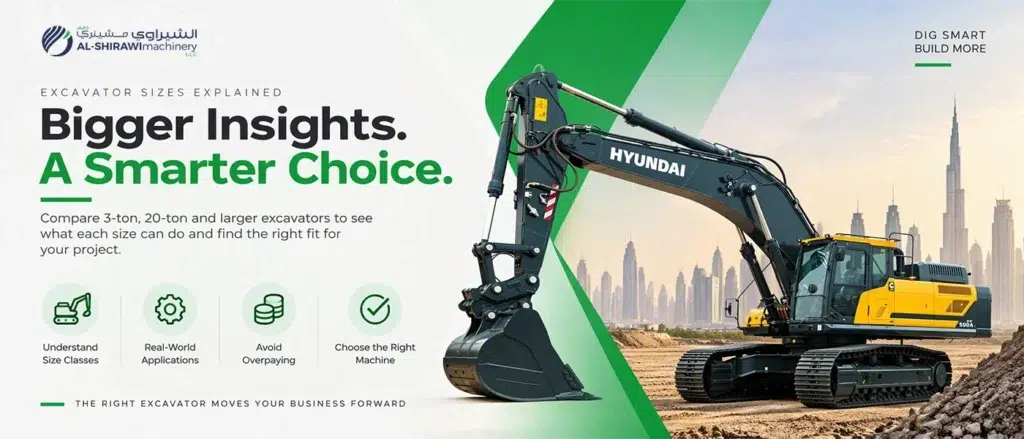
Excavators are classed by operating weight. Weight drives digging force, reach, lifting capacity and stability, and it decides how the machine reaches your site.
| Size class | Typical use | Roughly how it travels | Best for |
| 3-ton | Landscaping, small trenches, utility connections | Small trailer or light truck | Gardens, villas, narrow access |
| 5-ton | Drainage, footings, small site prep | Trailer | Utilities, small builds, roadside work |
| 20-ton | General construction, roadwork, bulk digging | Lowbed trailer | Mixed-duty contractors |
| 30-ton | Heavy excavation, large foundations | Lowbed, often with permits | Infrastructure, large sites |
| 40-ton | Bulk earthmoving, deep cuts, quarry loading | Lowbed with permits, sometimes split loads | Major civil works, quarrying |
Treat these as classes, not exact figures. Manufacturers’ operating weights vary by model, attachments and undercarriage.
Tonnage is shorthand for operating weight: the machine with fluids, operator and standard equipment. A heavier machine generally gets a bigger engine, stronger hydraulics, a longer boom and arm, and a larger bucket. It also gets a counterweight, which lets it lift and dig without tipping.
Three practical limits follow from weight:
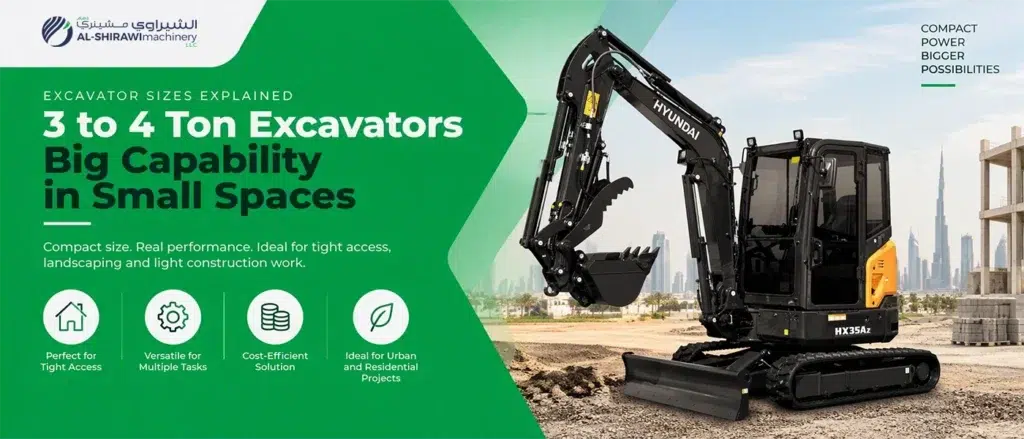
A 3-ton excavator is the right tool when space is the constraint. It fits through gates, works beside walls and can run in a villa garden without wrecking it. Typical jobs include landscaping, swimming pool excavation, service trenches and small demolition with a breaker.
Its limits are real. Depth is shallow, bucket capacity is small, and you won’t move bulk material quickly. If most of your work involves hard ground or large volumes, a 3-ton machine will frustrate you.
In the Al Shirawi Machinery range of Hyundai excavators, the nearest match is the Hyundai HX35AZ mini excavator, with an operating weight of roughly 3.8 to 4.1 tons, built for compact construction, landscaping and utility work.
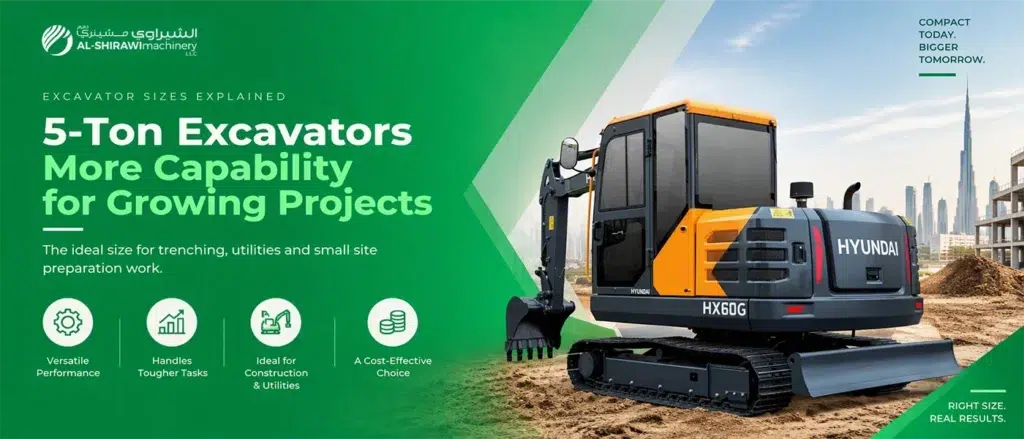
A 5-ton digger is the step many small contractors outgrow into. It digs deeper and faster than a 3-tonner, handles hydraulic attachments such as breakers and augers better, and has the stability to lift materials with confidence. Drainage runs, footings, kerb work and small site preparation all suit it.
It still travels on a trailer, so you avoid the cost and planning of a lowbed. For a business that digs trenches daily but rarely needs bulk volume, this is often the sweet spot.
The Hyundai HX60G, at about 5.85 tons, sits at the upper end of this class and gives extra capacity for construction, utility and site preparation tasks.
If one machine could cover most of a contractor’s work, it would be a 20-ton excavator. This class handles foundations, road construction, trenching for larger pipes, loading trucks and general earthmoving. Buyers and rental fleets both favour it because resale value holds up and parts and attachments are easy to find.
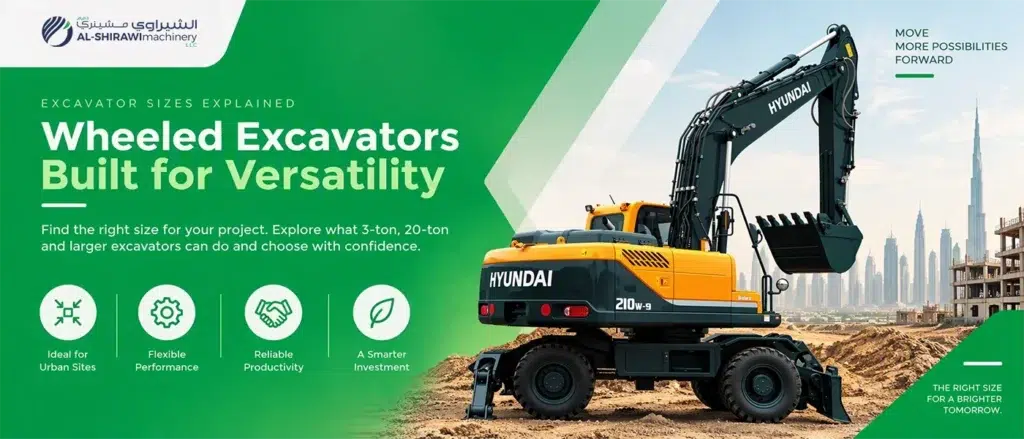
One decision matters here: tracks or wheels.
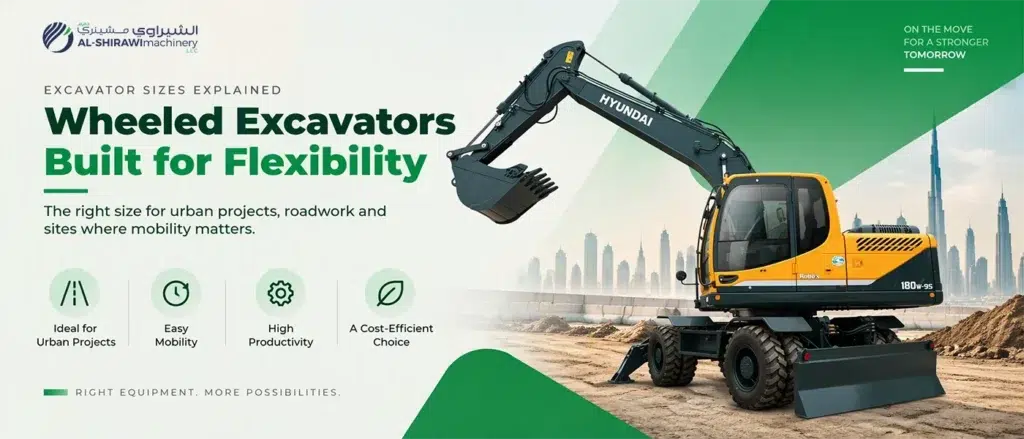
Al Shirawi supplies both, across the full Hyundai heavy equipment range. The R210W wheeled excavator is a 20.5-ton class machine built for reach and productivity, and the HX220HD crawler works at 22 tons for construction and earthmoving.
A 30-ton excavator moves a noticeably larger bucket per cycle, digs deeper and loads trucks faster than a 20-tonner. Large foundations, deep trenches and infrastructure projects benefit. The jump in output is meaningful, and the machine stays manageable on most sites. The HX300SG, at roughly 29.5 tons, falls in this class.
A 40-ton excavator pays back when volume is high and the schedule is tight. Think bulk earthmoving, deep cuts, quarry loading and major civil works. The cost of moving the machine is higher, and the site needs the space and ground strength to carry it.
For this class, look at the R430LC, at about 42.6 tons, or the HX360L and HX380L, which sit between 35 and 37 tons — all listed in the full excavators range.
Work through these in order. Most buyers have their answer by the third.
Buying for the biggest job you can imagine. A machine you use at 40 percent capacity still costs 100 percent of its transport, depreciation and servicing.
Ignoring transport. A 30-ton machine is no bargain if every move costs a lowbed hire and a permit wait.
Overlooking lift capacity. Digging force and lifting force are different specifications. Check the lift chart at the radius you’ll actually work.
Forgetting the ground. Soft sand and wet ground need the wider footprint of a crawler or a heavier counterweight. Hard rock demands more breaker power.
Treating the purchase price as the cost. Servicing, parts availability and downtime often outweigh the price difference between two similar models.
Two identical excavators can perform very differently depending on who services them. In hot, dusty conditions, filters, hydraulic components, cooling systems and undercarriage wear fast, and a day lost waiting for a part costs more than most buyers budget for.
Before you commit to any size, ask:
Al Shirawi has supported construction and heavy equipment across the UAE for over 40 years, with workshop facilities, trained technicians and a central genuine parts warehouse at Dubai Investment Park 2 supplying branches across Dubai, Sharjah, RAK and Abu Dhabi. It’s worth treating that support as part of the machine you’re buying.
Choosing Your Excavator Size with Confidence
Choosing between excavator sizes comes down to matching the machine to your regular work, your sites and your support. A 3-ton or 5-ton digger earns its keep where access is tight. A 20-ton is the dependable all-rounder. A 30-ton or 40-ton machine pays off when volume is the priority.
If you’re weighing up options, Al Shirawi Machinery can talk you through them. The team supplies Hyundai crawler, wheeled and mini excavators, and backs them with genuine spare parts, after-sales service and maintenance support across the UAE.
- Sales: 04 371 8585 | inquiries.asm@alshirawi.ae (Monday to Friday, 8am to 6pm)
- After sales: 800HDH-800434 (toll free) | asm.service@alshirawi.ae (Monday to Friday 8am to 6pm, Saturday 8am to 5pm)
- Branches: Al Quoz and Dubai Investment Park 2 in Dubai, and Musaffah in Abu Dhabi
- Website: www.alshirawimachinery.com
Tell them about your site, your typical jobs and how you move the machine, and they’ll help you choose the size that fits.
For a standard villa, a 5-ton to 20-ton machine usually does it. Smaller plots with limited access suit a 5-ton digger. Larger plots, deeper basements or heavy soil suit a 20-ton.
Yes, for shallow service trenches, garden drainage and small utility connections. For deeper or longer trenches in hard ground, a 5-ton machine is more productive.
A 30-ton machine has a larger bucket, more reach and more lifting capacity, so it moves more material per hour. A 20-ton is cheaper to transport and easier to place on tighter sites.
Output depends on bucket size, soil type and operator skill, so quoted hourly figures vary widely. What stays constant is that the class suits bulk earthmoving and truck loading at high volume.
Choose crawlers for soft or uneven ground and heavy digging. Choose wheeled machines for roadwork and sites where the machine travels often.
Yes, and it’s sensible if you’re unsure between two sizes. Renting for a few weeks shows you what the machine does on your actual sites.
Measure gates, overhead clearances and ground conditions, and ask your dealer for the machine’s transport and working dimensions before committing.

Share your requirement — our team will reach out shortly.

