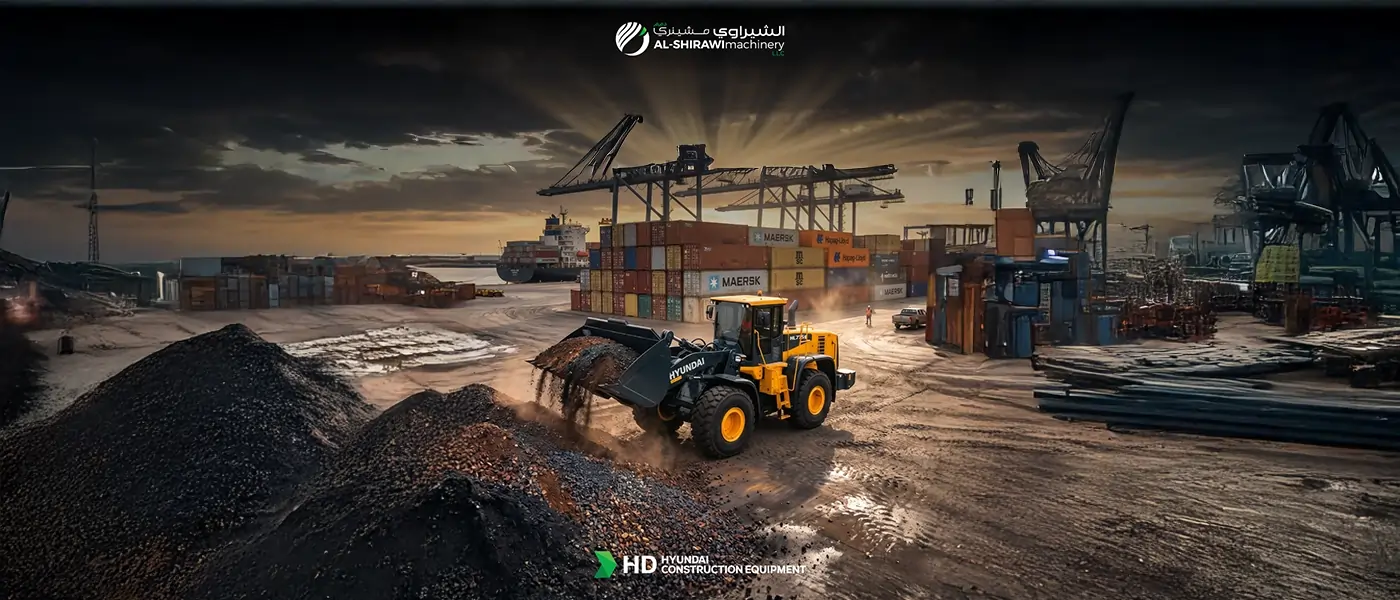
Buying a wheel loader is a decision that affects your site’s productivity for years, so it pays to know what you’re looking at before signing anything. This guide covers what a wheel loader does, the specifications that actually matter, how to match a machine to your application, and what separates a good investment from a costly one.
It’s written for site managers, procurement teams, and contractors across the UAE weighing up a wheel loader for sale against their project’s real workload, not just the spec sheet numbers. Whether you’re loading trucks at a quarry, moving aggregate at a ready-mix plant, or handling waste at a recycling facility, the right wheel loader can cut cycle times, lower fuel costs, and reduce downtime.
As the exclusive dealer for Hyundai Heavy Construction Equipment in the UAE, Al Shirawi Machinery has spent decades helping contractors, quarry operators and industrial businesses choose, maintain and maximise the performance of their wheel loaders. This guide draws on that experience to help you make a more informed investment decision.
A wheel loader is a heavy machine mounted on four wheels, fitted with a front-mounted bucket used to scoop, lift, carry, and load loose material such as soil, sand, gravel, or demolition debris. It’s also known as a front-end loader, pay loader, or bucket loader depending on the region.
The machine works through a hydraulic lift and tilt system that raises and dumps the bucket, combined with an articulated or rigid frame that lets the operator turn tightly in confined spaces. Power comes from a diesel engine driving all four wheels, giving the loader traction to push into stockpiles and climb loading ramps.
Most wheel loaders on UAE sites fall into the mid-to-large category, generally between 15 and 30 tonnes operating weight, because that range handles the volume and cycle speed that quarrying and construction work demands. Smaller loaders exist for landscaping and light material handling, but they’re built for a different job entirely.
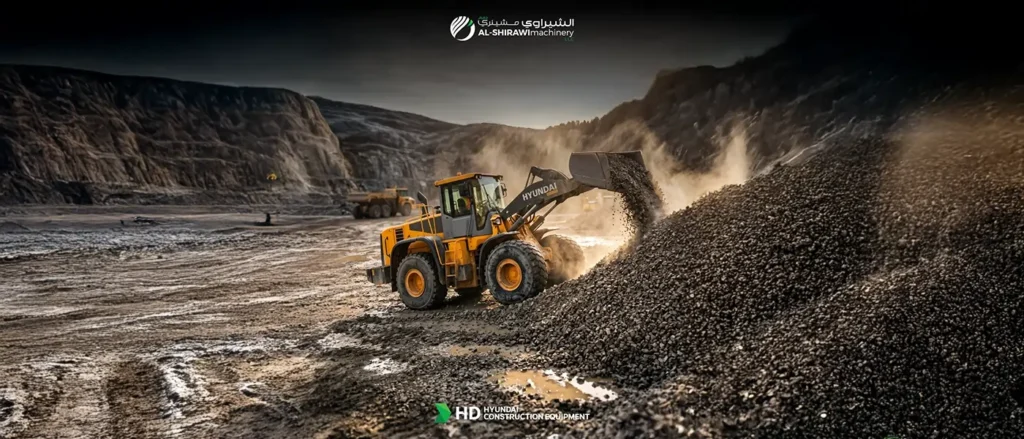
A wheel loader earns its keep across several sectors and knowing where yours will spend most of its hours should shape every decision that follows.
Each application puts different stress on a machine. A loader ideal for a quarry with high breakout force, big bucket, built for abrasive material isn’t necessarily the best fit for a recycling yard that needs tighter turning and lower ground pressure.
Spec sheets are dense, but only a handful of numbers actually predict how a wheel loader performs on your site.
Heavier machines generally move more material per cycle, but only if your trucks and ground conditions can support that scale. A loader too large for the trucks it’s feeding wastes fuel; one too small forces extra cycles.
This measures how much force the bucket can exert when digging into a stockpile. It determines whether a loader can push cleanly into compacted or dense material without stalling or excessive wheel spin critical for quarry and aggregate work. The Hyundai HL775-9, for example, delivers 20,800 kgf of breakout force, which is what allows it to handle continuous aggregate loading without losing cycle speed.
Engine output (kW or hp) affects both digging force and travel speed on ramps. Hydraulic cycle times affect how fast the bucket raises, tilts, and dumps directly impacting loads completed per hour, often the single biggest driver of site productivity.
This is the maximum height the bucket can reach, which determines whether the loader clears the sides of the trucks or hoppers you’re loading. Get this wrong and you’ll be underloading trucks or risking spillage. It’s why the Hyundai HL760-9’s 4,105 mm hinge pin height suits standard tipper trucks, while the Hyundai HL775-9’s 6,005 mm reach is built for taller haul trucks on high-volume sites.
Fuel is usually the largest ongoing cost over a machine’s working life. Small differences in consumption per hour compound quickly across a multi-shift operation.
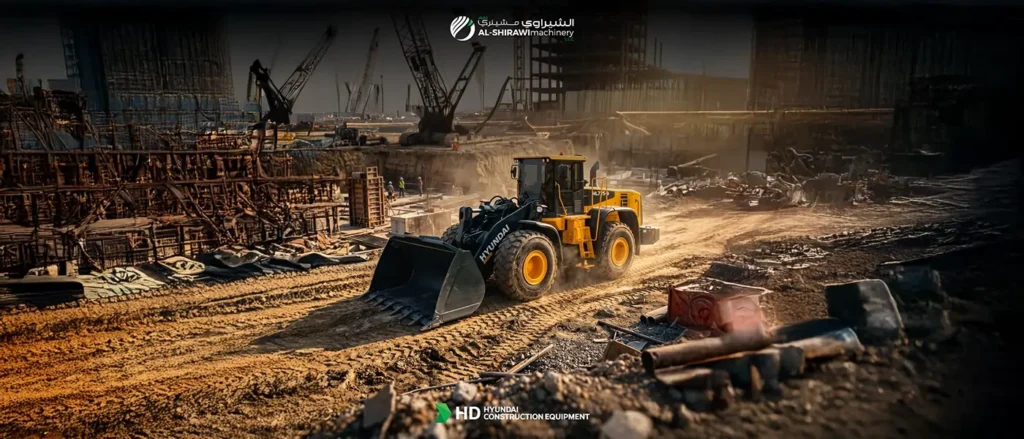
Follow this sequence rather than starting with a specific model in mind to keep the decision grounded in your actual workload.
Wheel loader price in the UAE varies based on operating weight class, engine specification, attachments, and whether the machine is new or used. As a rule, larger operating weight and bucket capacity push price up, while engine technology that improves fuel efficiency can offset some of that cost over the machine’s lifespan.
Other factors that influence the final price of a loader for sale include warranty coverage and length, included attachments (forks, multi-purpose buckets, quick couplers), the dealer’s support network and parts availability, and any financing or leasing terms on offer.
A lower upfront price on a pay loader for sale isn’t automatically the better deal if it comes with weaker after-sales support or higher fuel consumption. Experienced buyers weigh purchase price against five to ten years of operating costs, not just the number on the quote.
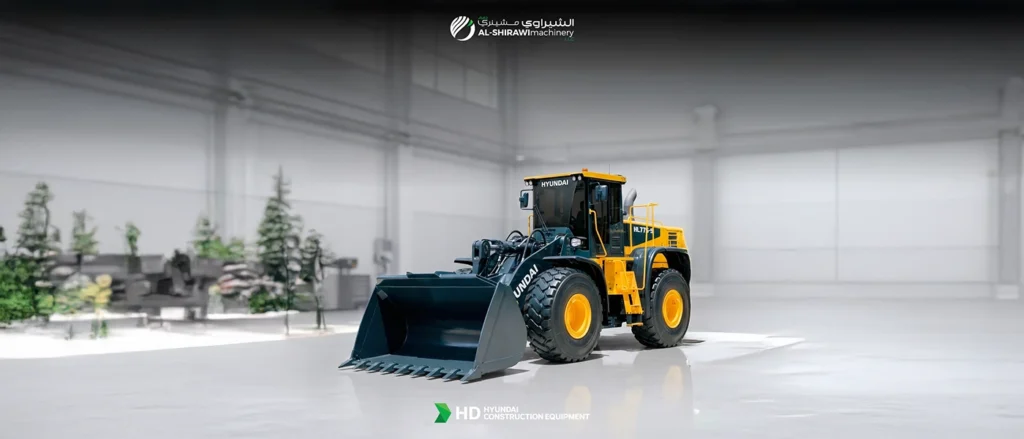
Al Shirawi Machinery supplies both the Hyundai HL760-9 and HL775-9 wheel loaders, and the choice between them usually comes down to scale of operation.
| Specification | Hyundai HL760-9 | Hyundai HL775-9 |
| Operating weight | 17.9 tonnes | 24.6 tonnes |
| Bucket capacity | 3.3 m³ | 4.5 m³ |
| Rated power | 160 kW @ 2,100 rpm | 335 hp @ 2,100 rpm |
| Engine model | Cummins QSB6.7 | Cummins QSM11 |
| Tipping load (straight) | 13,840 kg | 20,000 kg |
| Maximum travel speed | 25.2 km/h (reverse) | 39 km/h |
| Hinge pin height (max lift) | 4,105 mm | 6,005 mm |
| Best suited for | Construction, general material handling, and mid-volume sites | Quarrying, ready-mix plants, high-volume loading, and port operations |
The HL760-9 suits contractors who need a versatile, moderately sized loader for varied construction tasks where manoeuvrability matters as much as raw capacity. Its 4,105 mm hinge pin height and 13,840 kg tipping load make it well suited to loading standard tipper trucks on general sites.
The HL775-9 is built for operations where volume and breakout force are the priority — quarry faces, aggregate stockpiles, and continuous truck loading. Its 20,800 kgf breakout force and fast front-end cycle times (raise in 5.4 seconds, lower in 3.4 seconds, dump in 1.5 seconds) keep trucks moving without long waits between loads, while its 6,005 mm hinge pin height gives it the reach to clear larger haul trucks.
For contractors weighing up either class, it’s worth discussing your daily tonnage target directly with a specialist, since the right choice often isn’t obvious from the brochure alone.
A wheel loader’s real cost is spread across its working life, not just the invoice. Routine maintenance including; engine oil, hydraulic fluid, filters, and undercarriage checks, keeps a machine running at rated performance and protects resale value. Skipping service intervals is one of the fastest ways to shorten a loader’s lifespan and trigger expensive failures.
Genuine Hyundai spare parts are designed to maintain performance, reliability and warranty compliance. Through Al Shirawi Machinery’s UAE parts network and factory-trained service teams, operators can minimise downtime and keep machines working at peak efficiency throughout their lifecycle.
Owners get the best results by following the manufacturer’s service schedule strictly, keeping a maintenance log to anticipate part replacement, training operators on proper load techniques to reduce drivetrain wear, and budgeting for servicing as a planned operating cost rather than a surprise expense.
A wheel loader is one of the highest impact purchases a construction, quarrying, or material handling operation will make, and the right decision comes down to matching the machine’s specifications to your actual daily workload rather than chasing the biggest numbers on a spec sheet. Operating weight, breakout force, bucket capacity, and after-sales support all deserve equal attention alongside wheel loader price. Working with an experienced authorised dealer also helps protect that investment through expert advice, ongoing servicing and reliable access to genuine Hyundai parts for years after purchase
Whether you’re comparing a compact loader for sale against a heavier-duty machine or specifically weighing up the Hyundai HL760-9 against the HL775-9, the goal is the same: a machine that keeps your site productive, your fuel costs predictable, and your downtime to a minimum. Getting this right at the buying stage pays off for years afterward.
Looking for a Reliable Wheel Loader?
As the exclusive Hyundai Heavy Construction Equipment dealer in the UAE, Al Shirawi Machinery helps businesses not only select the right wheel loader, but also keep it operating reliably with factory-trained service engineers, genuine Hyundai spare parts and nationwide after-sales support.
Contact Al Shirawi Machinery
Email: marketing.asm@alshirawi.ae
Get in touch today to request a quote, book a demonstration, or speak with a specialist about Hyundai wheel loader pricing and availability across Dubai, Abu Dhabi, and the wider UAE.
“Pay loader” is simply another regional term for a wheel loader, the machines are the same.
Wheel loader price depends on operating weight class, engine specification, and attachments. Larger, higher-capacity machines cost more upfront but can lower cost per tonne moved on high-volume sites.
This depends on your daily material volume, truck sizes, and site conditions. As a rule of thumb, match bucket capacity so it fills your trucks in three to four passes.
Follow the manufacturer’s recommended service intervals: daily checks plus scheduled maintenance at set operating-hour intervals for engine oil, hydraulic fluid, and filters.
New machines offer full warranty coverage and predictable maintenance costs, preferred by many UAE operators for continuous work. Used loaders lower upfront cost but carry more uncertainty around remaining component life.
The HL760-9 is a 17.9-tonne machine with a 3.3 m³ bucket, suited to general construction and mid-volume material handling. The HL775-9 is a heavier 24.6-tonne loader with a 4.5 m³ bucket and 20,800 kgf breakout force, built for quarrying, ready-mix plants, and high-volume truck loading.
Yes. With the right attachments; forks, multi-purpose buckets, or quick couplers, a wheel loader can switch between material handling, stockpiling, and light lifting tasks, making it a versatile machine for mixed-use sites.
Al Shirawi Machinery is an authorised Hyundai construction equipment dealer supplying new wheel loaders, genuine parts, and after-sales support across all seven emirates.

Share your requirement — our team will reach out shortly.

