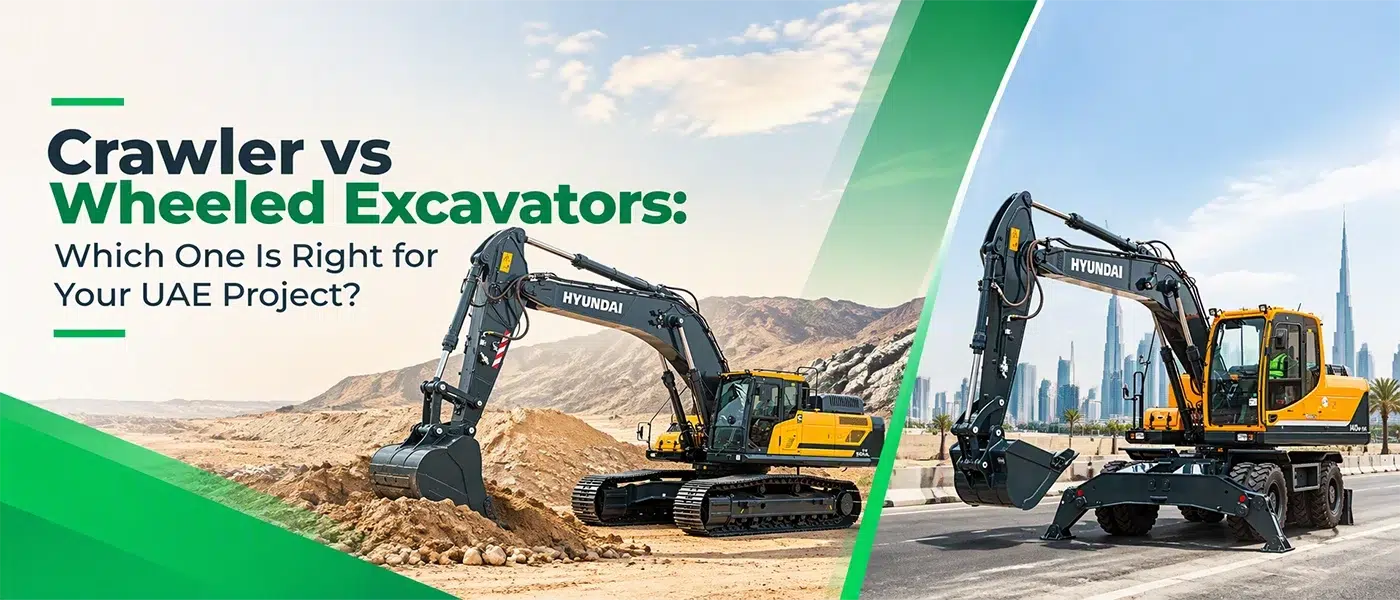
Two jobs land on the same desk in the same week. One is a utilities contract: six kilometres of trenching along live city roads, with a new site every few days. The other is bulk earthworks on an open plot, with months of digging on soft, sandy ground. The budget covers one new machine.
Pick the wrong excavator and you either lose hours every week to transport and repositioning, or you spend your days stuck in sand. Choosing between a crawler excavator and a wheeled excavator is mostly a question of where your machine will spend its working life.
Choose a wheeled excavator if your work is on paved or firm ground and the machine needs to move between sites under its own power. Choose a crawler excavator if your work is on soft, uneven or rocky ground, or if you need maximum digging force, lifting stability and size.
| Wheeled excavator | Crawler excavator | |
| Best ground | Paved roads, compacted or hard surfaces | Sand, soft soil, rock, slopes, uneven ground |
| Moving between sites | Drives itself on the road | Usually needs a low-loader |
| Stability when digging | Good, with outriggers and blade down | Excellent, with a low centre of gravity and wide footprint |
| Size range at Al Shirawi Machinery | 13.7 to 20.5 tonnes | 22 to 81.6 tonnes |
| Typical work | Roadwork, utilities, urban construction, landscaping | Mining, quarrying, bulk earthworks, pipelines, deep excavation |
| Surface wear | Gentle on asphalt and paving | Tracks can damage finished surfaces |
The upper structure, cab and boom do the same job on both machines. The difference is underneath.
A crawler excavator sits on steel or rubber tracks. The load spreads over a large contact area, so the machine floats over soft ground and grips on slopes. It also stays planted when you swing a heavy bucket.
A wheeled excavator, sometimes called a tyre excavator or tire excavator, rides on rubber tyres. It drives at road speed, works without a transport truck, and leaves paving intact. On soft ground it loses grip and stability, which is the trade-off.
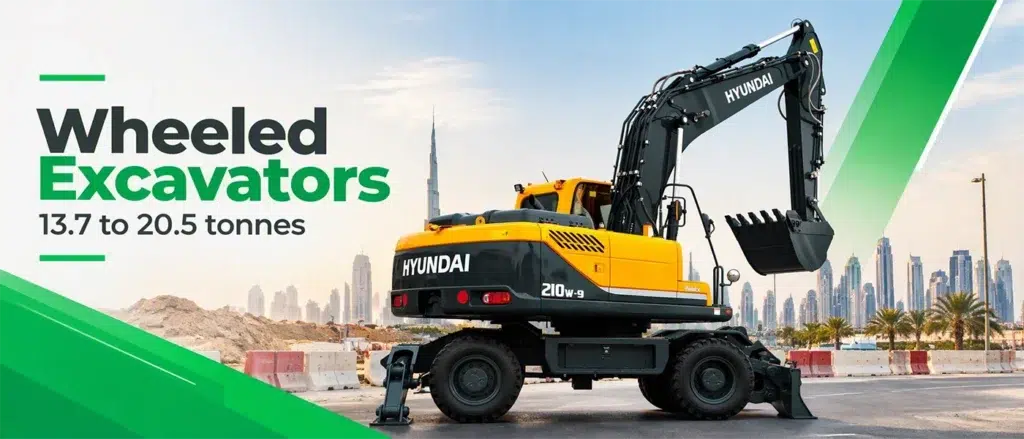
Wheeled machines pay off when you move often. Every relocation that doesn’t need a low-loader saves a booking, a driver and usually half a day.
Al Shirawi Machinery’s range of Hyundai wheeled excavators include:
If your fleet spends its days on roads, junction upgrades, drainage, cable routes or municipal work, a wheeled excavator in the UAE usually makes sense. The machine arrives, works, and drives to the next site.
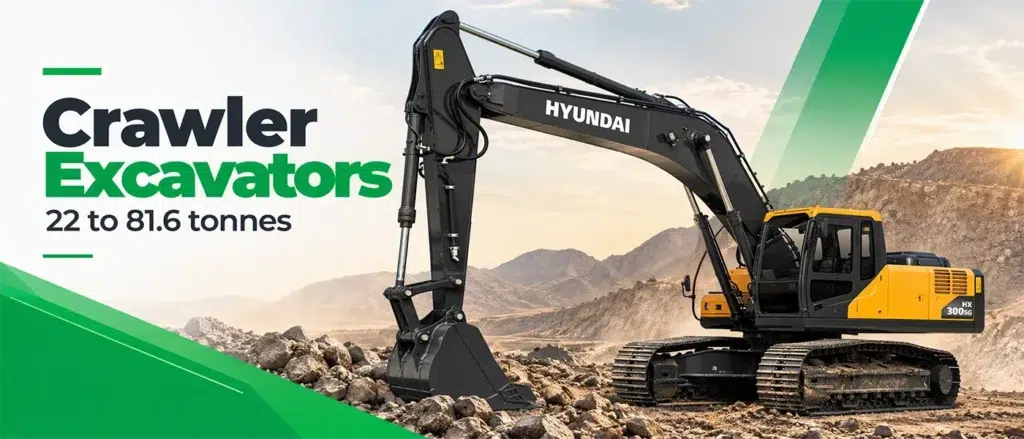
Some work needs the grip and stability of tracks, and size is the other reason to go crawler. Hyundai’s crawler line at Al Shirawi runs from 22 to 81.6 tonnes, far beyond any wheeled machine.
If the ground is loose sand, the slope is steep, or you’re digging rock or deep foundations, tracks win. Bulk earthworks also favour a crawler excavator, because you stay on site and the extra stability lets you load trucks faster.
Local conditions deserve their own look, because they affect running costs as much as the spec sheet does.
Ground. Sand is the usual problem. Tyres lose traction quickly in loose dunes and soft fill, so projects on desert edges, new plots and unconsolidated ground usually favour a crawler excavator. Compacted sites and finished roads suit wheels. This is especially true in quarrying, where rock face excavation and overburden removal almost always call for a crawler.
Heat and dust. Both machine types work hard in summer. Daily checks on cooling systems, filters and hydraulic oil matter more here than in cooler climates. The undercarriage also behaves differently. Track wear speeds up in abrasive sand and rock, while tyre wear speeds up on rough, sharp surfaces and with frequent road travel.
Site hopping. Dubai, Abu Dhabi and Sharjah projects often involve short jobs spread across the city. If you spend a lot of money moving machines, wheels save money. If you stay in one place for weeks, tracks cost nothing extra in transport.
Surface rules. Many urban sites and finished roads don’t allow tracked machines to travel on them, or they need protection first. A wheeled excavator avoids this problem.
Answer these honestly and the choice usually becomes obvious.
Mixed fleets are common too. Many contractors run a wheeled excavator for roadwork and a crawler excavator for earthworks, and the two support each other well. If you’re also weighing up smaller machines for tight sites, our guide on mini excavator vs crawler excavator covers that comparison in more depth.
| Project | Better fit | Hyundai models to look at |
| Road maintenance and urban trenching | Wheeled | R140W, R180W |
| Utilities and pipe-laying in the city | Wheeled | R180W, R210W |
| Landscaping and light excavation | Wheeled | R140W |
| Quarry loading on firm ground | Wheeled | R210W |
| General construction and site prep | Crawler | HX220HD, HX300SG |
| Pipeline and civil infrastructure | Crawler | HX360L, HX380L |
| Deep excavation and quarrying | Crawler | R430LC |
| Mining and rock excavation | Crawler | HX500L, HX800L |
Buying wheels for sand. The machine drives fine on the showroom floor and struggles on soft fill. Work out your worst ground, not your average.
Ignoring transport costs. A crawler excavator can look cheaper to buy, then the low-loader bills add up on projects that move often.
Buying too small. A smaller bucket means more cycles and slower production. If you regularly load trucks, size the machine to the haul fleet.
Treating service as an afterthought. Downtime costs more than a service contract does. Check who supplies parts, how fast, and how close the workshop is.
Whichever machine you pick, the total cost comes from fuel, wear parts and downtime. Undercarriage components, tyres, hydraulic hoses and filters all wear faster in UAE conditions, so a service plan matters as much as the machine.
Al Shirawi Machinery is the exclusive authorised Hyundai Heavy Equipment dealer in the UAE. That means access to genuine Hyundai spare parts, after-sales support, and maintenance programmes, so you’re not sourcing components from several suppliers when a machine goes down. Planned maintenance catches wear early, while genuine parts keep warranty cover intact and the machine performing as designed.
The Right Excavator Is the One Matched to the Ground
For roads, utilities and constant relocation, a Hyundai wheeled excavator saves time and transport costs. For soft ground, heavy digging, rock and scale, a crawler excavator is the safer and more productive choice. If your work is split, run both.
If you’re still weighing it up, talk through your site conditions with the team at Al Shirawi Machinery. They can match a Hyundai crawler excavator or wheeled excavator to your project and set up service with genuine spare parts support from day one.
- Sales: 04 371 8585, inquiries.asm@alshirawi.ae (Monday to Friday, 8am to 6pm)
- After sales: toll-free 800HDH-800434, asm.service@alshirawi.ae (Monday to Friday 8am to 6pm, Saturday 8am to 5pm)
- Branches: Al Quoz and Dubai Investment Park (Dubai), and Musaffah (Abu Dhabi)
- Online: alshirawimachinery.com, where you can request a quote for any model
A crawler excavator runs on tracks, which gives better grip, stability and flotation on soft or uneven ground. A wheeled excavator runs on tyres, which lets it drive between sites and work on paved surfaces without damaging them.
Not usually. Tyres lose traction in loose sand and soft fill. For desert or unconsolidated ground in the UAE, a crawler excavator is generally the better choice.
It depends on the job. Wheeled machines save on transport if you relocate often. Crawlers can cost less over time on long single-site projects, but track wear is higher in abrasive sand and rock. Total cost depends on utilisation, ground and maintenance.
Al Shirawi Machinery supplies three: the R140W (13.7 tonnes), R180W (18.5 tonnes) and R210W (20.5 tonnes). Larger work calls for a crawler.
The range runs from the 22-tonne HX220HD up to the 81.6-tonne HX800L, with the HX300SG, HX360L, HX380L, R430LC and HX500L in between.
It can handle moderate lifting, but for heavy lifting, deep digging and demolition, a crawler’s wider, lower stance gives more stability.
It’s a large continuous-digging machine used in major surface mining. It’s a different category of specialised machinery from the construction excavators discussed here.
Yes. Al Shirawi Machinery provides after-sales support, maintenance, and genuine Hyundai spare parts across the UAE.

Share your requirement — our team will reach out shortly.

